The Oscars: Still Beautiful, Rarely Surprising
Hollywood’s most glamorous night struggles to reinvent the language of the red carpet.
Before you dive into this article and the spectacle of the red carpet, take a moment to read this.
In light of the still ongoing situation in the world the conflicts, the violence, the uncertainty that continues to affect millions of lives it is important to remember something about the industries we work in.
As creatives, artists, actors, writers, designers, and cultural voices, we carry a responsibility. No matter how big or small our presence is within an industry, our duty remains the same: to speak.
Platforms, stages, and global events like the Oscars are not only spaces for celebration and glamour. They are also some of the most visible microphones in the world. To stand on such stages and choose silence, or to believe that speaking about real human suffering is “irrelevant” to the moment, becomes something else entirely an act of indifference.
And indifference is dangerous.
When artists speak, even briefly, they remind the world that culture is not disconnected from reality. That cinema, fashion, music, and art exist within the same world where people struggle, resist, hope, and survive.
These gestures may seem small, but silence would be far smaller.
Moments like these remind us that cultural platforms do not only celebrate talent they amplify voices. And when those voices are used to advocate for humanity, dignity, and peace, they carry a weight far beyond the red carpet.
As you move forward into this article and the conversation around fashion, glamour, and spectacle, keep this in mind: behind every event, every stage, and every spotlight, there is a world that continues to demand awareness.
And sometimes, the most powerful thing someone can do with a microphone is simply to use it.
-Mo Sabra Editor-in-Chief, Spiral Corner
The Oscars remain one of the most glamorous nights in culture. Black tuxedos, sculpted gowns, diamonds under unforgiving flashes the visual language of Hollywood prestige. But if we are being honest, the red carpet itself has started to feel strangely predictable.
Every year we expect spectacle. Every year we receive elegance. But fascination? That is becoming rarer.
The silhouettes are familiar. The styling is safe and the glamour is rehearsed.
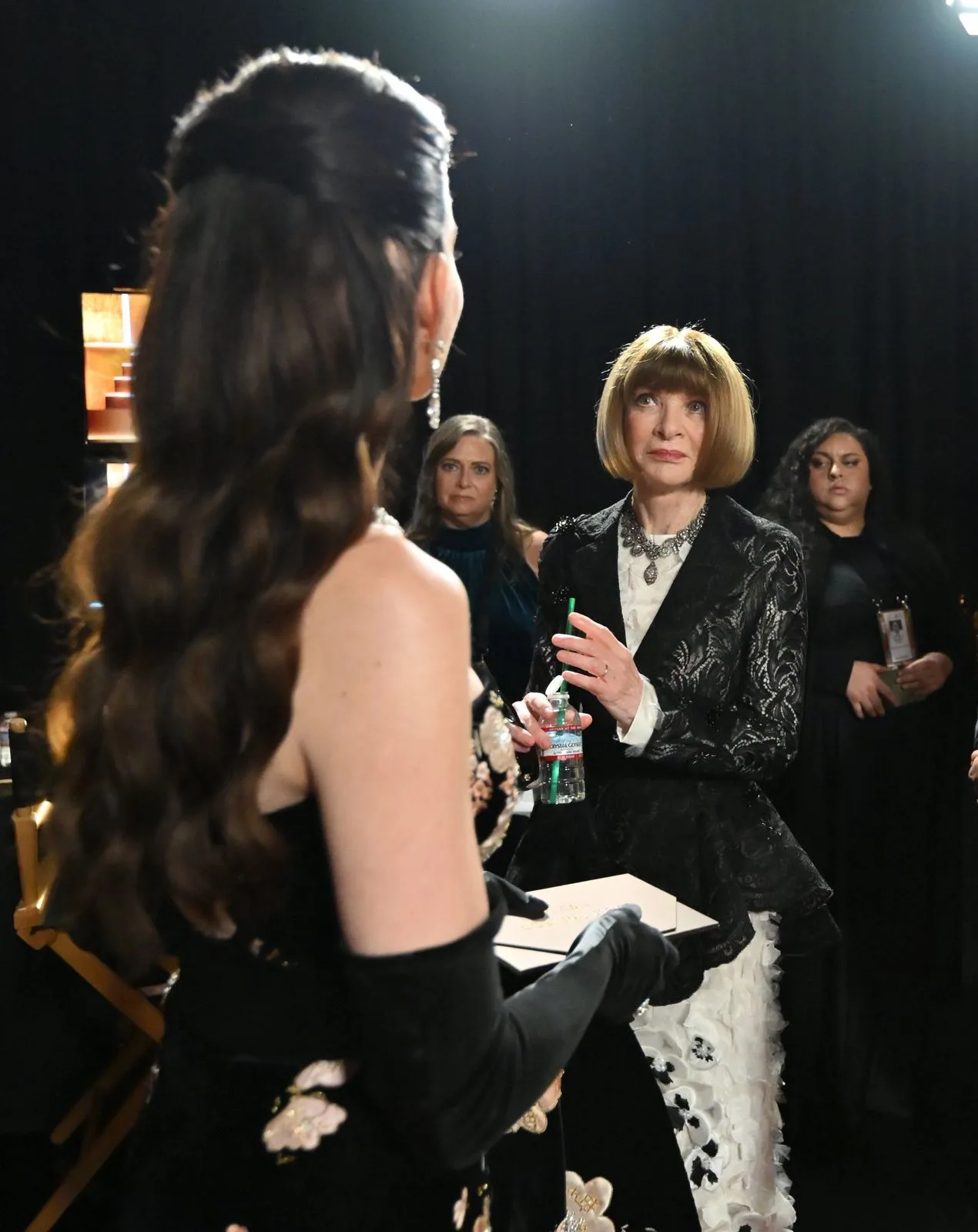
This year’s carpet delivered beauty, certainly but very little shock to the system.
Actors like Zendaya once again proved why they dominate modern red carpets, appearing in a sculptural look from Louis Vuitton that balanced futuristic glamour with classic polish. Anya Taylor-Joy leaned fully into old-Hollywood fantasy in a delicate creation from Dior, while Margaret Qualley embodied quiet cinematic elegance in Chanel.
Mia Goth arrived in her signature gothic minimalism, wrapped in dark romanticism from Saint Laurent, and Teyana Taylor turned the carpet into performance in a dramatic custom look by Schiaparelli one of the few outfits that actually flirted with spectacle.
Julia Fox, predictably unpredictable, rejected traditional red-carpet codes altogether in an avant-garde ensemble that felt closer to performance art than fashion diplomacy. Meanwhile Hunter Schafer continued her quiet domination of modern fashion storytelling in a fluid look from Prada understated, controlled, and intellectually styled.
Elsewhere, Jeff Goldblum and Emilie Livingston embraced theatrical glamour, Goldblum in a richly textured tuxedo from Prada, proving that personality can still animate traditional menswear.
And yet, despite the craftsmanship, the diamonds, the couture something about the carpet itself felt... expected.
We know what the Oscars look like before they even begin.
Black tuxedos. Strapless gowns. Old Hollywood references dressed as modern statements.
The formula works, but formulas rarely fascinate.
Which might explain a pattern that has become increasingly clear in recent years: the after-party has quietly become more interesting than the ceremony itself.
Once the official carpet ends, the rules relax. The silhouettes become sharper, the styling more instinctive. Celebrities stop dressing for legacy photographs and start dressing for expression. Mini dresses replace gowns. Latex replaces silk. Vintage pieces collide with experimental styling.
The Oscars red carpet performs glamour. The after-party experiments with it.
And perhaps that is where the future of red carpet culture lies.
Because glamour itself is not the problem. The Oscars are supposed to be glamorous. The black tie, the gowns, the theatricality it is part of the mythology of cinema. But mythology can evolve.
What is missing is risk.
Not chaos, not costume but experimentation. A willingness to reimagine what glamour can look like today. Fashion moves forward through reinterpretation, not repetition.
And repetition has begun to dominate the carpet.
There is also a deeper styling problem that appears every year: the confusion between extravagance and cohesion.
Fashion does not become interesting simply because colors are mixed together or pieces are layered dramatically. Styling is not about accumulation it is about coherence. Some looks this year tried to manufacture drama by stacking textures, colors, or references together, but without a clear visual logic.
True fashion has an eye to it.
A red dress with a red shoe, a black glove with a black lip, a silhouette that holds together from the first flash of the camera to the last. Cohesion is what transforms clothing into image. Without it, even the most expensive garment collapses into noise.
Still, beyond the clothes, the night offered moments that mattered more than fashion.
Actors like Javier Bardem used their brief moments in front of the microphone to speak directly about war and human suffering. Others, including Saja, echoed the sentiment that the world remains deeply interconnected that conflict in one place reverberates everywhere.
In a ceremony often criticized for its self-celebration, those few seconds of advocacy felt strangely powerful.
Because the Oscars exist within a strange contradiction.
It is a night of extreme luxury diamonds, couture, global attention yet it also offers one of the largest cultural microphones in the world. And occasionally, someone uses that microphone for something larger than cinema.
When that happens, the glamour becomes something else entirely.
It becomes context.
Perhaps that is the real tension of the modern Oscars. It is no longer just a fashion event, nor purely a film ceremony. It is a stage where culture, politics, celebrity, and fashion collide sometimes elegantly, sometimes awkwardly.
But if the ceremony wants to remain visually exciting, one thing must change.
The carpet must dare again.
Because audiences today have seen everything. Couture gowns no longer shock us. Diamonds no longer hypnotize us. Beauty alone is not enough to hold attention in a world saturated with images.
The only thing left that can still fascinate us is intention.
Fashion that means something, that surprises us, fashion that feels alive.
Until then, the Oscars red carpet will continue to deliver elegance but the real experimentation will keep happening somewhere else, just a few hours later, at the after-party.
***Spiral Journal*** **by Spiral Corner**