The Body as Armature: When the Met Gala Becomes a Museum Installation
How the 2026 Met Gala transformed the red carpet into a site of “Costume Art,” where bodies became living frameworks for meaning.
From an outsider’s point of view, the Met Gala always promises spectacle but this year, with a theme rooted in costume as art, the expectation was something deeper, more intentional.
What makes a look truly compelling isn’t just the garment itself, but the reference behind it the history it pulls from, the narrative it carries, the decision to mean something. That’s where the night becomes interesting. That’s where it either holds, or falls apart.
Some guests understood that. They arrived with clarity, with intention, with references that could be traced and felt. Others, however, seemed to exist on the surface as if the look was assembled last minute, without depth, without conversation.
Because at the end of the day, it’s not just about what is worn. It’s about how it is performed. The posture, the attitude, the drama the ability to embody the look rather than simply present it.
And sometimes, disruption speaks the loudest. There’s something to be said about showing up differently about rejecting expectation altogether. In that sense, Bhavitha Mandava’s decision to appear in jeans becomes its own kind of statement.
Have a good read.
-**Mo Sabra** Editor-in-Chief, Spiral Corner
The ascent up the Metropolitan Museum of Art’s steps has always been regarded as a grandiose performance, but yesterday, the stage itself underwent a tectonic shift. We aren’t just talking about a change in guest lists; we are talking about the inauguration of the Condé M. Nast Galleries, a sprawling 12,000-square-foot expansion that fundamentally alters the museum’s footprint – a permanent statement of intent.
The atmosphere reflected this newfound permanence through a landscape titled “The Immortal Garden”. Moving away from the traditional red, the carpet was a tan, hand-painted pathway designed by Derek McLane and Baz Luhrmann to resemble an ancient Northern Italian stone garden. Patches of hand-painted moss crept across the stone, while a literal cloud of wisteria hung overhead, which lined the tent’s ceiling and walls. It was a space designed to suggest that these guests, and the garments they wore, had been there for a very long time.
At Spiral Corner, we often discuss the “drop”, the ephemeral moment where a movement takes hold. But the 2026 Met Gala was about reclaiming “fashion’s dignity”. It served as the Met’s “definitive yes” to the exhausted debate of whether fashion belongs in a fine art context. By framing the theme around the relationship between the dressed body and the visual arts, the gala repositioned the human form as a collaborator rather than a mere hanger.
Decoding the “Costume Art” Theme
Before we look at the individual movements on the carpet, we have to understand the language of the night. The 2026 theme was a dual-sided coin, and those who succeeded understood the difference between the Exhibition Narrative and the Red Carpet Directive.
**The Exhibition (Costume Art):** Curated by Andrew Bolton, this is the academic “Archive”. It pairs nearly 400 objects – garments and fine art spanning 5,000 years – to show that fashion is the thread connecting every department in the museum.
**The Dress Code (Fashion Is Art):** This was the “Live Performance”. It invited guests to treat their ensembles as living masterpieces, emphasizing sculptural silhouettes that could reshape, distort, or reimagine the body.
**The Interpretation:** The night demanded we look past the “pretty dress”. Guests were encouraged to lean into the “intentionally ugly” or the “grotesque” to challenge traditional standards of beauty, often referencing the “Lived Experience”, including bodies typically ignored by the art canon, such as the pregnant, aging, or disabled body.
Exhibits of “Costume Art”
Last night, we truly walked through a living catalog of human form and friction. Here are some of the most potent interpretations of the night:
***The Anatomists & The Biological***
Some guests completely leaned into the exhibition’s focus on diverse body types and their styling.
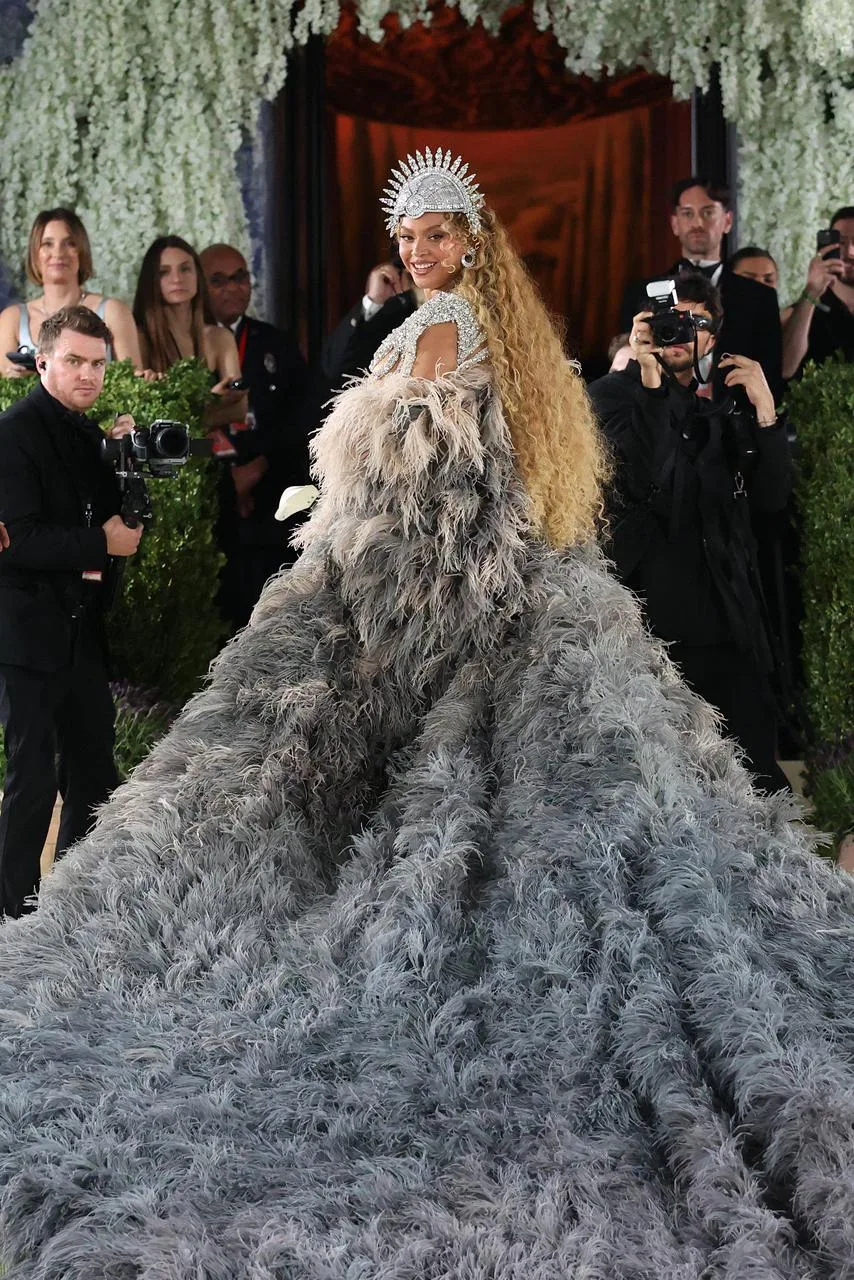
**Beyoncé - Olivier Rousteing**
Queen B was back for her first Met appearance since 2016, and she did not disappoint. Alongside her daughter and husband, she wore a diamond-encrusted skeleton design that mapped the “beauty of the natural body” over a sheer base, whose details were very intricate, finished with an expansive feather opera cape. Beyoncé’s entrance was spectacular, as her cape trail seemed to be endless and made her look majestic.
**Kim Kardashian - Allen Jones x Whitaker Malem**
Kim, who is known for wearing pieces that center around the waist, wore a literal piece of “Body Armour,” featuring a fiberglass breastplate modeled in the 1960s and painted in sunset orange.
**Bad bunny - Custom Prada**
Bad Bunny was unrecognizable as he walked the steps in a theatrical exploration of the “aging body” theme, leaning into a dignified, structured silhouette complete with a cane.
**Lisa - Robert Wun**
Lisa wore a crystal-embellished gown featuring two 3D-printed arms, modeled on her own body, which reached out to hold her veil in a hauntingly beautiful display of self-collaboration, complete with an ethereal makeup look.
**Jordan Roth - Robert Wun**
Jordan exhibited a profound exploration of the *Myth of Pygmalion and Galatea*, featuring a gray velvet sheath dress with a faceless statuette hauntingly sprouting out of his back.
**Sabine Getty - Ashi Studio**
Sabine went with a literal manifestation of “life imitating art,” where a bejeweled finger on her dress was mirrored by her own real-time posing. The painting on her dress on the upper part of her body focused on the hand placement on her chest and waist.
***The Surrealists & The “Intentionally Grotesque”***
Here, the directive to “be art” meant challenging traditional standards of beauty through distortion and “lumps and bumps”.
**Madonna - Saint-Laurent**
Madonna stunned in a look inspired by the painting “The Temptation of St. Anthony” by Leonora Carrington (1945), featuring a ghost ship headpiece and a long veil carried by seven “ladies-in-waiting.” She made sure to pose with her girls at every step, and rearranged their positions constantly as her veil gave the illusion that she was floating.
**Cardi B - Marc Jacobs**
Cardi B gives a nod to Hans Bellmer’s Surrealist dolls, featuring sheer black lace paired with exaggerated “muscle” padding and towering 9.5-inch boots.
**Lena Mahfouf - Buc Akyol**
Lena Mahfouf gave a beautiful interpretation with a draped skirt anchored by lifelike silver hands molded onto her body, acting as a bustier that left just enough to the imagination.
**Sarah Paulson - Matières Fécales**
Sarah went for a biting social caricature of “The One Percent,” wearing a grey destroyed-looking tulle ball gown and a one-dollar bill blindfold mask, which earned her a heated debate on socials.
**Doechii - Custom Marc Jacobs**
Doechii channeled a subversion of the typical gala “glamour,” wearing a wispy, maroon asymmetric wrap dress completely barefoot, accented only by intricate henna designs.
**Alex Consani - Custom Gucci by Demna**
Alex Consani showed a masterclass in reveal and concealment, featuring a white faille cape that opened to expose a nude tulle corseted bustier accented with black feathers.
***The Archivists***
These looks were direct dialogues with the museum’s 19 curatorial departments, bridging the gap between historical masterpieces and modern textiles.
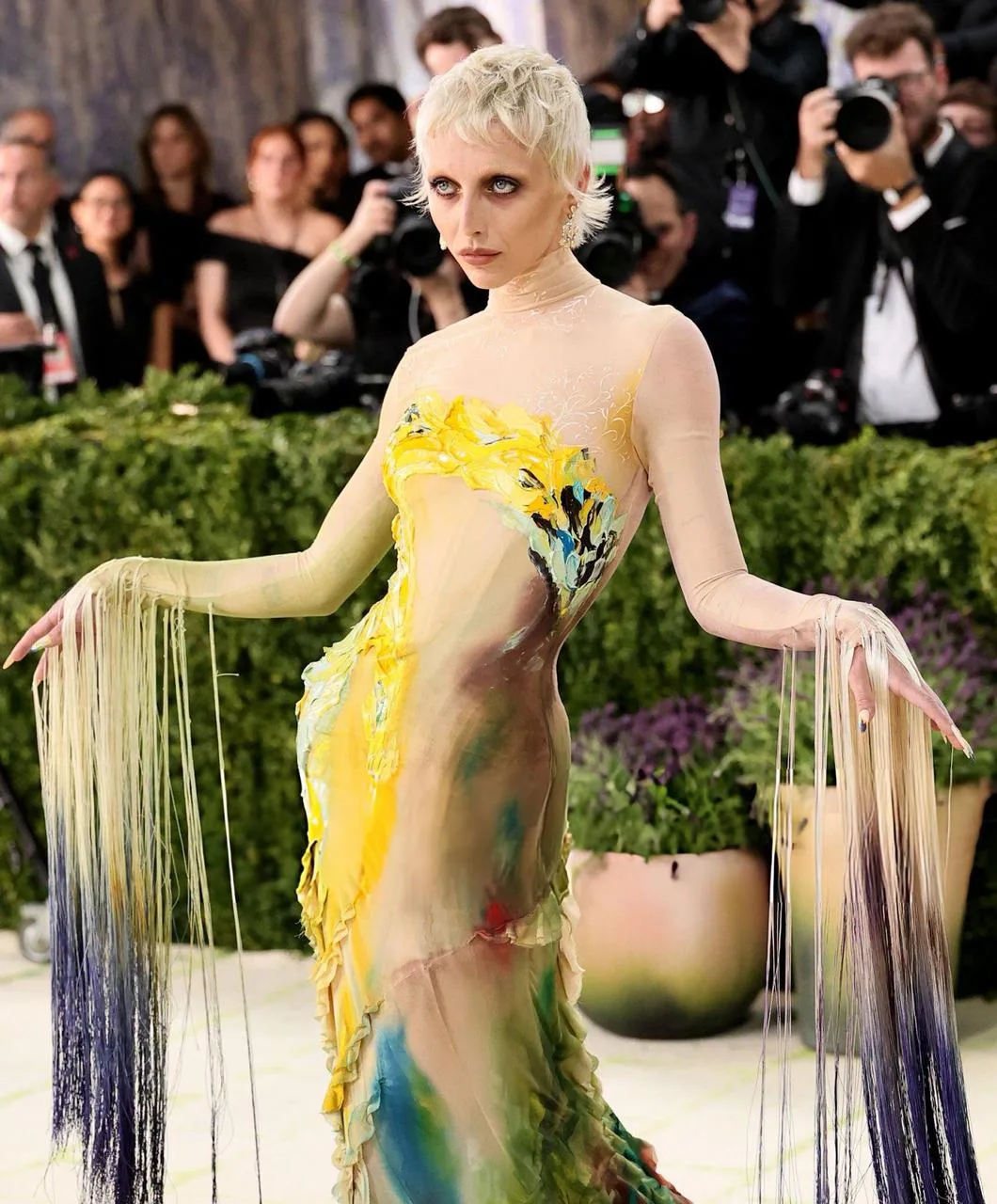
**Emma Chamberlain - Mugler**
Emma Chamberlain arrived at the 2026 Met Gala as a “living canvas,” wearing a custom Mugler gown designed by Miguel Castro Freitas. The look featured a nude-illusion base hand-painted by artist Anna Deller-Yee with a watercolor gradient of acid yellow, moss green, and inky blue. Inspired by archival Mugler butterfly motifs, the gown combined an ethereal, artistic aesthetic with an “ominous” edge, perfectly capturing the “Fashion is Art” theme. The cherry on top? The matching nails that complemented her beautiful bird-like appearance.
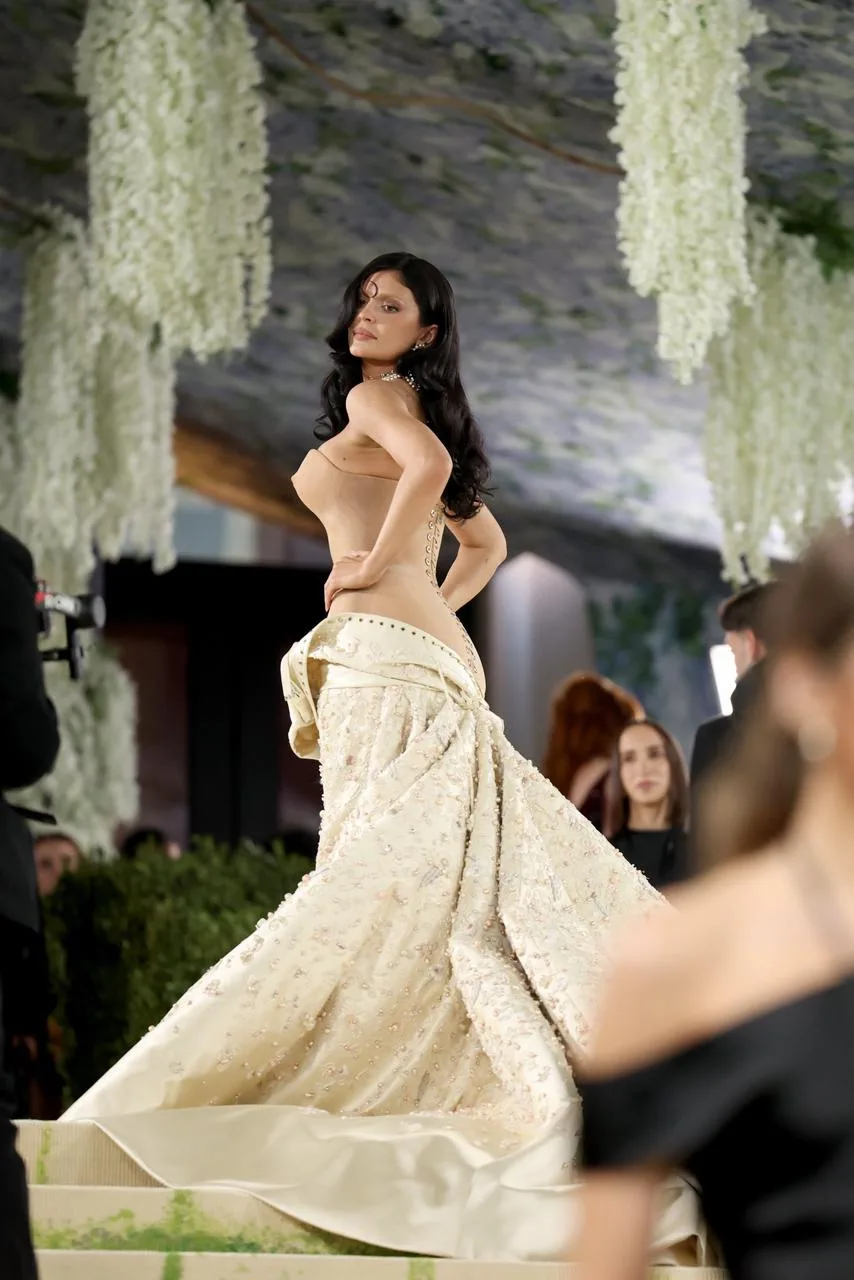
**Kylie Jenner - Schiaparelli & Kendall Jenner - GapStudio**
The Jenners were a sister act in nude bustiers from Schiaparelli and GapStudio, respectively, each of which featured a sculpted breastplate complete with prosthetic nipples. Kylie had a skirt shimmering with 10,000 pearls, while Kendall had material twisted and torqued over her corset.
**Angela Bassett - Prabal Gurung**
Angela Basset was a beauty in a vibrant homage to Laura Wheeler Waring’s *Girl In a Pink Dress*. The artwork is nearly 100 years old, and Basset deemed it an important part of her culture.
**Charli XCX - Yves Saint Laurent**
Charli wore a piece from the SS88 couture collection paying homage to Van Gogh’s “Irises.” One of Yves’s favorite pieces, and one of his favorite flowers, often given to his favorite muses. A little underwhelming, perhaps more color was expected.
**Rosé - Saint Laurent**
Rosé wore a new dress inspired by Henri Matisse’s “The Birds.” Sharp, minimalistic, punctuated by a diamond Tiffany & Co. bird brooch at the hip
***The Abstract & Material Future***
The final movement prioritized “illegible” silhouettes and unconventional materials, moving fashion into the realm of pure sculpture.
**Rihanna - Maison Margiela**
Rihanna, accompanied by A$AP Rocky, stunned with a custom “living sculpture” that defied traditional garment logic and, famously, the event’s schedule. Her look featured a dazzling metallic gold and gunmetal gown covered in jewels, paired with a gold headpiece. She said she wanted this look to be strong, timeless, and intentional from every angle. The creative vision for Rihanna’s crystalline hair was what the hairstylist described as “artefact-like beauty.”
**Doja Cat - Custom YSL**
Doja wore a skin-tight, nude-toned draped silicone dress that blurred the line between fabric and skin. The gown used Grecian draping to mimic the way fabric falls over marble sculptures, aiming for a “timeless” quality that blurred the line between a garment and a historical monument.
**Naomi Osaka - Robert Wun**
Naomi went for a visceral “Body in Pain” look: a white gown with red paillettes erupting from gaping, dark-red “gashes” in the fabric.
**Katy Perry - Stella McCartney**
Katy Perry’s ensemble was a conceptual commentary on artificial intelligence and her own history with viral “deepfake” images. She wore a strapless white gown made from repurposed Italian deadstock duchess satin and a chrome, face-obscuring mask designed by Miodrag Guberinic.
**Tyla - Custom Valentino**
Tyla looked stunning as she wore a peacock-inspired ensemble that utilized aquamarine pumps to anchor a fluid, color-shifting aesthetic. The makeup paired with it beautifully, and reflected as she walked and moved.
**Notes From the Field**
To capture the true essence of the evening, one must look at the gaps between the art – those sharp, unscripted moments where the persona and the piece collided in the “Immortal Garden”:
**The Repetitive:** Anna Wintour, the architect of the evening, opted for an ensemble that felt remarkably repetitive of her previous year’s look. In a night dedicated to radical “Costume Art,” the orchestrator chose the safety of a familiar silhouette.
**The “Off-Theme”:** While the directive was “Fashion Is Art,” guests like Gigi Hadid notably missed the mark. Her ensemble lacked alignment with the evening’s sculptural and conceptual mandate, opting for a traditional glamour that felt detached from the “Costume Art” narrative.
**The Narrative Bait:** Georgina Rodríguez provided the night’s most modern piece of performance art. By leaving her hotel in casual sweats, she successfully misled the digital discourse before making a dramatic pivot into a formal gown for the carpet.
**The Accessible Canvas:** In a vital move for the institution, the event integrated inclusivity as a core design principle. The evening featured participants from the disabled community, with ensembles styled specifically around their bodies to frame them as central “canvases” for art.
**The Power Play:** Last night, the Met Gala traded its creative soul for a $10 million entry fee from Jeff Bezos and Lauren Sánchez. As Silicon Valley replaces legacy fashion houses as the primary patron of high culture, the event has pivoted from a night of artistic whimsy into a corporate “Billionaire Circus”. The friction was impossible to ignore: with $75,000 tickets pricing out the avant-garde, icons like Zendaya and Meryl Streep reportedly declined to come, while protesters outside decried the “exploitation” funding the festivities. For Spiral Corner, the message is clear – when access is bought rather than earned, the gala ceases to be a movement and becomes a sterile display of unbridled power.
**Beyond the Velvet Rope**
In the end, the 2026 Met Gala did not simply blur the line between fashion and art, it dissolved it entirely, replacing spectacle with intention and ornament with inquiry. What unfolded was less a red carpet and more a curated confrontation between body, object, and power, where garments functioned as arguments rather than adornments. And yet, within this heightened conceptual rigor, a select few managed to do what the night demanded at its highest level: not just wear the art, but become it – effortlessly, provocatively, and with lasting resonance.
SPIRAL CORNER’S BEST DRESSED
Emma Chamberlain
Beyoncé
Sabine Getty
Kendall Jenner
SPIRAL CORNER’S HONORABLE MENTIONS
Alex Consani
Jeremy Pope
Doechii
Madonna
**Written by:** Tayma Saliba **Editor’s Note:** Mo Sabra ***Spiral Journal*** **by Spiral Corner**