Fashion as Political: The Body & The Mechanical Arm
The body as object and the aesthetics of control
This piece does not ask whether fashion is political, it dismantles the comfort of that question altogether. What begins as inquiry quickly reveals itself as exposure: of systems, of bodies, of the illusion of choice. Through McQueen, Coperni, and the mechanical, endless gesture of control, the article traces a quiet violence embedded in aesthetics. One that does not impose, but seduces. This is not a reflection on fashion, but a confrontation with it. A reminder that what we wear is never neutral, and that the body, whether resisting or complying, is always already inside the machine.
-**Mo Sabra** Editor-in-Chief, Spiral Corner
*Why is fashion political?* What an interesting question... I realize now, perhaps a little shamefully, that I have never asked myself this. ‘Fashion Is Political’ always struck me as an axiom: something so undeniably true that it did not require proof or argument. Why *is* fashion political?
Fashion is, of course, an art form. A manner of self-expression dating as far back as that fabled garden of Eden, fashion is likely one of the first ways humans embodied commentary, belief, and identity.
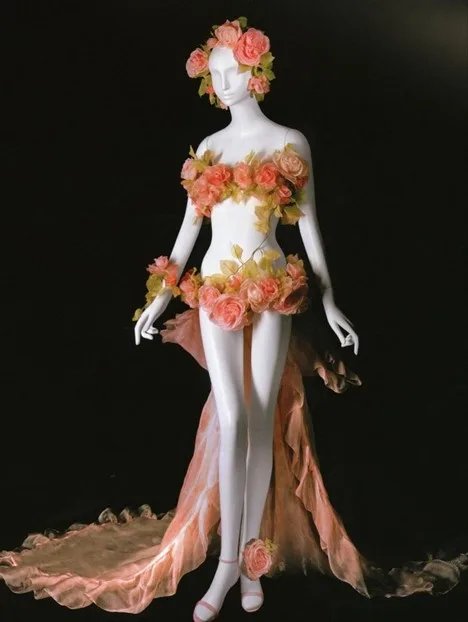
Although these characteristics have evolved today to include capitalistic purposes like the reflections of trends and consumer behavior, fashion remains an ever-evolving cultural phenomenon that is, at its core, a practice of representation. So yes, I suppose that is what makes fashion political, right? Wrong.
*“We often refer to something as being ‘political’, or ‘all about politics’, to mean it boils down to a power struggle between people or groups. The idea is that politics is a process of maneuvering to assert rival interests.”*
Politics is, at its core, the negotiation and distribution of power between people: who is visible, who is protected, who must continuously justify their presence within its sphere. Fashion operates directly within this system because it determines *the body*’s legibility, dressing it for the public gaze.
Thus far, my discussion has only encompassed the *subject* of fashion: its message, the ideologies and beliefs it represents. We have yet to speak of the *object*: the body. And the body is, undeniably, political. No body exists outside systems of interpretation. The moment a body enters public space, it is read according to existing structures of gender, class, race, desirability, ability, and power. To possess a body is to be subjected to interpretation.
This is why the question almost answers itself. Fashion is political not simply because clothing can express ideology, but because its primary site of operation, the body, is itself political. And the body is not merely political because it can represent ideology, but because it is continuously acted upon by systems attempting to regulate its appearance, behavior, and movement through public space.
This is what makes fashion such an effective political mechanism; few people experience it as a force. It arrives instead as desirability, imitation, self-surveillance, and the fear of social illegibility. Fashion actively teaches the values it wants us to perform. Control, after all, functions best when it appears voluntary, and fashion is one of the most effective control systems we have precisely because it does not feel like one.
**Alexander McQueen, 1999, Shalom Harlow, No. 13**
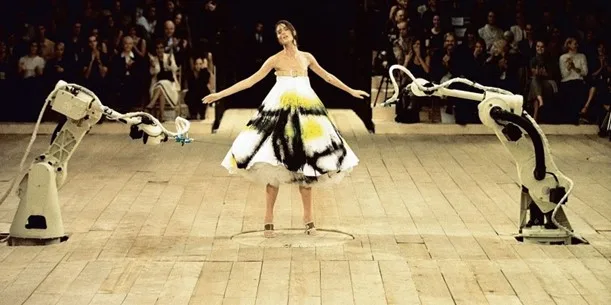
Harlow had a vague idea of what was going to happen on that runway; she was simply told she would be attacked by robots. You can see her covering her face and mouth in anticipation, gesticulating and undulating hither and tither, trapped on a rotating platform. Two robotic arms flank her, and soon they begin to spray paint her white dress with wet, inky black and a poisonous looking yellow green. You can see her face change as she realizes the dress is being painted; she almost seems relieved that this was all ‘attacked’ had meant. Notice the surprise register on her face and crash throughout her body as her signature flightiness exaggerates.
In No. 13, the body resists incorporation. Harlow appears vulnerable, at times frightened, reactive. We see machines that look like they belong in a garage, machines that build commodity, building a woman. McQueen flaunts this show of control, refusing to aestheticize it, spraying the subject onto an unknowing and seemingly non-consenting object.
**Coperni, 2022, Bella Hadid**
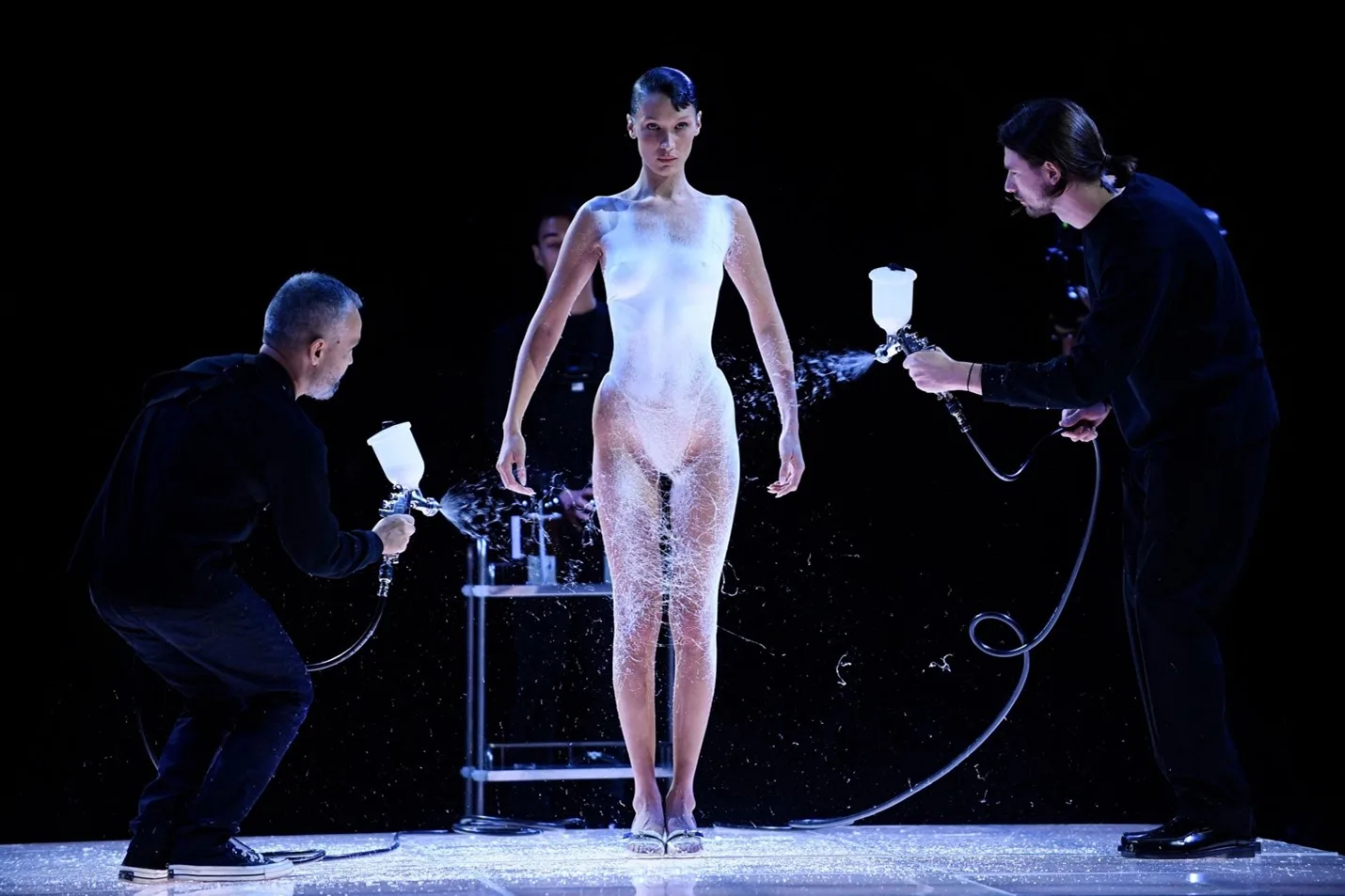
Coperni runs much of the same operation as McQueen does, with one element being completely different. Here, the object is aware and consenting. Hadid walks onto the stage near stark naked with a hand covering her breasts. She stands on a platform and is joined by two men who proceed to spray her with a white, fleshy substance. She looks calm, cool, and collected. She does not flinch. Slowly she raises the hand covering her breasts, exposing more and more of herself as canvas. Mere minutes later, as if by magic, the white flesh webs together and Hadid is wearing a dress.
In a few minutes which generated $26 million dollars in media value in 48 hours, Coperni exposes a show of control far more advanced than McQueen’s. The object, the body, is still being acted upon, but seems convinced that it is participant rather than medium. That illusory fallacy is where the control lies.
**Fashion & Control**
All this conjures to my mind one of my favorite art installations: Sun Yuang and Peng Yu’s *Can’t Help Myself*. In a pristine white room, a large mechanical arm is performing the seemingly Sisyphean task of mopping away a red blood-like, viscous substance that will not stop leaking out from under the machine. The arm appears purposeful, but its labor is endless and meaningless.
What unsettles me most about the installation is that the machine does not appear aware of its own futility. It continues operating regardless of whether the task can be completed. The performance of maintenance becomes more important than a resolution.
Seen alongside McQueen and Coperni, *Can’t Help Myself* reveals something uncomfortable about fashion systems: the body is not the center of the operation. Bodies change, age, fail, disappear, and are replaced. What persists is the structure: the endless regulation of appearance, the repeated correction of bodies toward whatever aesthetic order dominates a given moment.
Fashion’s political power lies not merely in *what* it communicates, but in *how*: while disguising that performance as freedom, individuality, or choice. The most effective systems of control are often the ones we learn to participate in willingly.
**Written by:** Rita-Maria Ibrahim **Editor’s Note:** Mo Sabra ***Spiral Journal*** **by Spiral Corner**